316L Stainless Steel
Custom marine stainless steel fabrication from Istanbul.
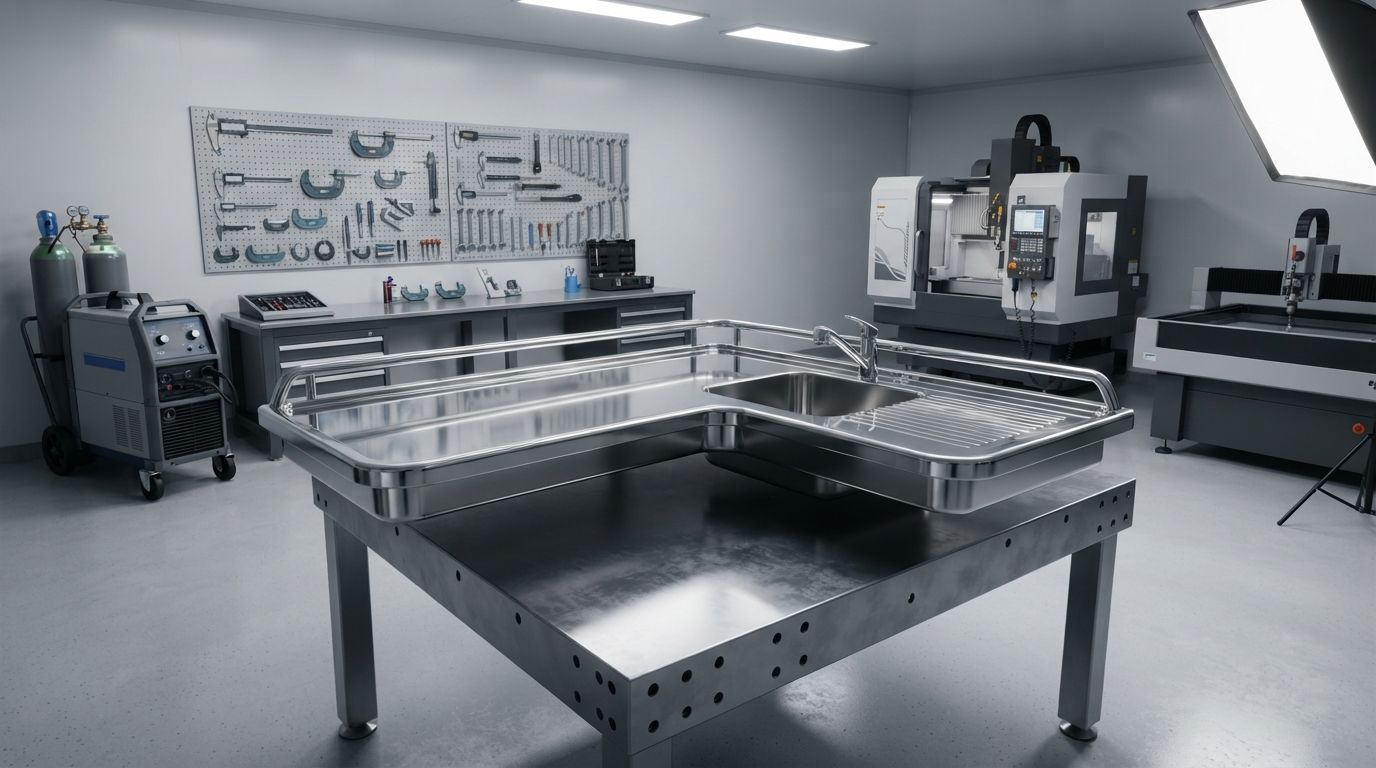
CNC-cut, TIG-welded, passivated 316L stainless steel fabrication for galley counters, laundry rooms, deck units, and structural components.
Marine 316L stainless steel fabrication is the production of custom equipment for superyachts and commercial vessels using AISI 316L grade stainless steel sheet via CNC laser cutting, TIG welding, surface finishing, and passivation. The molybdenum content of 316L provides resistance to the types of corrosion that 304 fails to resist in salt marine environments. Vista Marine fabricates galley counters, sinks, deck equipment, ventilation hoods, and laundry bases at its Istanbul Tuzla workshop and delivers to Mediterranean shipyards.
Fabrication Scope
What We Fabricate for Superyachts
Every project begins with a survey or design brief. We do not stock catalogue items and re-badge them — every piece is fabricated to the measured dimensions of your vessel, reviewed against your design intent, and finished to the agreed specification before it leaves Istanbul.
Galley Counter Systems
Full galley counter suites including integral sinks, over-shelf systems, oven housings, and service pass-throughs. Fabricated with reinforced under-bracing for equipment mounting loads up to 400 kg.
See projects →Sinks & Drain Systems
Single and double-bowl sinks from 2 mm sheet with integral overflow, waste, and drain fitting — sized to accept 1/1 gastronorm pot washing. Drain waste lines run to 50 mm BSP fittings standard.
See projects →Deck BBQ Stations
Outdoor deck BBQ housings in 316L with integral storage, folding service shelves, marine-grade gas valve blocks, and recessed drain grooves. Designed for teak-deck integration or composite deck mounting.
See projects →Pool & Swim Platform Drain Strainers
Laser-cut 316L perforated plate strainers for superyacht pools, deck drains, and swim platform gratings. Flush-mount frames welded to 316L drain boxes and bedded in marine sealant. Anti-clog geometry reduces maintenance frequency.
See projects →Ventilation Hoods & Canopies
Galley ventilation canopies with integral grease filter frames, UV lamp mounting rails, and balancing damper housings. Canopy geometry calculated from ventilation engineer's airflow requirements to achieve correct face velocity.
See projects →Laundry Anti-Vibration Bases
Welded 316L inertia-mass bases for professional marine washers and dryers. Designed to the vibration isolator specification for each machine model and base plate weight. Isolator pockets recessed into the base underframe.
See projects →Crew Mess & Pantry Fittings
Crew mess benches, galley storage racks, pantry shelf systems, and under-counter bin storage. Designed for compact spaces and high-cycle use. Anti-tip locks and closing dampers as standard on all drawer systems.
See projects →Custom Deck Furniture Frames
Structural 316L frames for sun loungers, daybed bases, bar trolleys, and outdoor dining table structures. Welded to the owner's designer's drawings and finished to mirror or satin as specified.
See projects →Material Science
316L vs 304 Stainless: Why Grade Matters on a Yacht
Both grades are visually identical. Both are corrosion-resistant in most environments. The difference emerges specifically in the presence of chlorides — salt water, salt air, and sodium hypochlorite cleaning agents — and it is a decisive difference in a marine context.
| Property | AISI 316L | AISI 304 |
|---|---|---|
| Chromium content | 16–18% | 18–20% |
| Nickel content | 10–14% | 8–10.5% |
| Molybdenum content | 2–3% (key difference) | None |
| Carbon content (L grade) | ≤0.03% (low carbon, weld-stable) | ≤0.08% standard |
| Chloride resistance | High — resists crevice corrosion in salt environments | Moderate — susceptible to pitting in chloride environments |
| Stress corrosion cracking | Resistant at ambient temperatures | Susceptible above 50°C in chloride solutions |
| Seawater immersion | Suitable for immersed components with correct passivation | Not recommended for permanent seawater exposure |
| Weldability | Excellent — low carbon prevents carbide precipitation at weld HAZ | Good — risk of carbide sensitisation in thick section welds |
| Passivation requirement | Required after fabrication and any surface grinding | Required after fabrication |
| Typical marine applications | Galley counters, deck fittings, pool drains, exhaust flanges | Non-marine commercial kitchens, interior architectural trim |
| Material cost premium vs 304 | +8–12% on raw sheet | Baseline |
All Vista Marine fabrications use AISI 316L as a minimum standard. For components in permanent seawater immersion (shaft seal housings, inlet strainer bodies), we specify duplex 2205 or super-duplex 2507 on request.
Our Method
The Fabrication Process: Survey to Installation
Tight shipyard tolerances and the complexity of integrating fabricated components into a vessel's existing structure demand a disciplined process. We do not guess measurements or adapt shore-kitchen templates to marine spaces.
Survey
We attend the vessel — wherever she is in the Mediterranean — and take physical measurements with laser distance tools and digital angle gauges. Hull camber, existing penetrations, equipment clearances, and structural frame positions are all recorded. For remote projects, we work from the builder's CAD files.
CAD Drafting
Survey data is transferred to our workshop CAD system within 48 hours. Fabrication drawings are produced to 1:10 scale minimum with all service connection positions, clearances, and material call-outs. Drawings are submitted for owner or yard approval before any material is cut.
Fabrication
CNC plasma or waterjet cutting ensures dimensional accuracy on complex profiles. Sheet forming is done on our CNC press-brake. TIG welding throughout — no MIG on visible surfaces or food-contact components. Weld beads are dressed to the agreed profile before the surface finishing stage.
Finish & Passivation
Surface finishing is to the agreed standard — satin (180-grit longitudinal grain), mirror (sequential grits to 600-grit + buff), or electropolished. Electropolishing produces a microscopically smooth surface that resists biofilm adhesion; it is specified for all food-contact items. All components receive nitric-acid passivation as a final step to restore the protective chromium-oxide layer after machining.
Delivery & Installation
Components are wrapped in protective film and custom-crated for sea freight or airfreight dispatch to any port. Our installation teams work directly in the yard or afloat. For complex multi-piece galley installations, we carry out a dry-fit in our workshop before crating, confirming assembly before the components reach the vessel.
Stainless Steel Guide
Technical guide for marine fabrication.
Fabrication FAQ
Frequently asked questions.
What exactly is 316L stainless steel and why is the "L" designation important? +
Why is 304 stainless not suitable for use on a superyacht? +
What is passivation and is it really necessary after fabrication? +
What is the difference between mirror and satin finish? Which is better for a yacht? +
What is electropolishing and when do you specify it instead of mechanical polishing? +
What is the typical lead time for a custom fabrication project from your Istanbul workshop? +
Can you ship fabricated components to a port other than Istanbul for installation by a local shipyard? +
Do you carry out repairs and refurbishment of existing stainless components, or only new fabrication? +
Who We Work With
From Shipyards to Yacht Owners
Our clients
Superyacht owners · Shipyards and refit yards · Naval architects and interior designers · Yacht management companies · Deck equipment engineers
Our fabrication and delivery regions
Turkey — Tuzla, Istanbul, Bodrum, Antalya · Spain — Palma de Mallorca · France — Monaco, Antibes, La Ciotat · Italy — Viareggio · Greece — Piraeus · Netherlands — Rotterdam
Vessel types we fabricate for
Superyacht · Motor Yacht · Sailing Yacht · Gulet · Commercial Vessel · Research Vessel
Vista Marine Production Standards
Precision marine fabrication since 2008.
Start Your Fabrication Project
Let’s fabricate your system.
Send us a GA drawing or even a photograph with dimensions. We will return a preliminary budget and a programme within three working days — no commitment required.