Superyacht Galley Refit: What to Expect from Start to Finish
A full superyacht galley refit moves through five distinct phases — from survey to commissioning. Here is what each phase involves and where delays are most likely.
Read guide →
← All Resources / Stainless Steel
Stainless steel is one of those materials that inspires false confidence. It looks the same, it costs roughly the same, and at a glance, 316L and 304 are indistinguishable. In a domestic kitchen, that distinction is irrelevant. On a vessel operating in salt water, it can mean the difference between a ten-year surface and a surface that starts showing rust in eighteen months.
The difference comes down to a single alloying element: molybdenum. Grade 304 contains 18% chromium and 8% nickel — the classic 18/8 formula that makes stainless steel stainless. Grade 316L adds 2–3% molybdenum to that formula, along with a slightly lower carbon content (hence the L). That molybdenum addition fundamentally changes how the steel behaves in the presence of chlorides.
Seawater contains roughly 19,000 ppm of chloride ions. Even in a galley several decks above the waterline, chlorides are present in the air, in spray, and in the produce being prepared. Chlorides attack the passive oxide layer that gives stainless steel its corrosion resistance. With 304, this attack can cause pitting — small, deep holes that form rapidly and are almost impossible to polish out once established. The molybdenum in 316L stabilises the passive layer against chloride attack, dramatically raising the material's pitting resistance equivalent (PRE). The PRE of 304 is around 18–19; for 316L it rises to 24–26. That numerical gap corresponds to a very different real-world outcome.
Crevice corrosion is a related failure mode that affects both grades but is significantly more aggressive with 304 in marine conditions. It occurs under gaskets, behind fastener heads, in weld seams, and wherever two surfaces trap a small volume of stagnant liquid. The oxygen in that trapped liquid is consumed and a concentration cell forms — a micro-environment where corrosion accelerates rapidly. On 304, this process can begin within months. On 316L, in the same conditions, it may take years to initiate.
Steel leaves the fabrication shop in a compromised state. Cutting, grinding, welding, and forming all introduce iron contamination to the surface — either from tooling, from the heat-affected zone around welds, or from cross-contamination with mild steel in the workshop. That surface iron corrodes rapidly and can stain an entire component. Passivation reverses this.
Passivation for marine-grade 316L typically involves a citric acid or nitric acid bath at controlled concentration and temperature. The acid dissolves the free iron from the surface without attacking the underlying chromium and nickel alloy. What remains is a clean chromium-rich surface that reforms its protective oxide layer quickly and completely. For onboard fabrications — counters, sinks, shelving, drain channels — passivation is not optional. Electropolishing goes further, levelling surface micropeaks that act as nucleation sites for corrosion; for deck hardware or items close to the waterline it is worth the added cost.
One practical note: if your fabricator uses mixed tooling — the same angle grinder on mild steel and stainless — you are introducing contamination regardless of the base material's grade. Specify dedicated tooling for stainless work. It is a simple requirement to add to a fabrication contract and it costs nothing.
The most common failure we encounter during refit surveys is 304 being used where 316L was specified. The material certificate may have been wrong, or a fabricator substituted grades to save cost. The difference only becomes visible twelve to eighteen months later, typically first at weld seams and drain penetrations. By that point, the corrosion is structural enough that replacement, not treatment, is the only answer.
A second common failure pattern is using 316L plate but 304 fixings. Screws, brackets, and studs are a detail that gets overlooked in procurement, but they are the components most exposed to stagnant moisture. A single 304 fastener through a 316L counter will show rust first at the fastener head and then spread staining outward — a process that looks like the counter itself is failing. Specify 316L or A4 marine-grade fixings throughout.
We have also seen failures attributable to incorrect welding wire. 316L base material welded with 308 filler — a common workshop error — produces weld beads that behave more like 304 in corrosive conditions. Any weld on a marine stainless component should use 316L compatible filler (316L or 317L), and the weld area should be passivated after fabrication.
304 is not a substandard material — it is simply the wrong tool for certain environments. In dry interior spaces, storage rooms, or cabinetry frameworks that will never see salt spray or standing water, 304 performs well and costs less. For structural elements behind cladding, 304 is perfectly appropriate. It is the exposed surfaces in galleys, laundry rooms, and especially deck areas where the grade distinction matters.
The Kalamış Marina restaurant project referenced in our portfolio illustrates the logic: we used 304 for counter tops (clean, food-contact surfaces with good drainage and regular cleaning) and 316L for the wall shelving (where salt air from the ventilation was a direct and continuous exposure). Same project, two grades, each correctly specified for its environment.
316L sheet commands a premium of roughly 15–25% over equivalent 304 in current European market pricing. For a typical superyacht galley counter and sink fabrication — perhaps 12–18 square metres of surface — that premium translates to €1,500–3,500 on a total fabrication cost of perhaps €18,000–35,000. Against the cost of a premature refit, or against the disruption of replacing corroded surfaces mid-charter season, the upgrade cost is trivial.
The calculation is different for large commercial vessels where surface areas are measured in hundreds of square metres. In those cases, a zone-based specification approach makes sense: 316L for galley surfaces, drain channels, and anything above deck, 304 for interior dry storage frameworks. This is how the specification decisions were made on our 1,200-passenger cruise liner project, where both grades appear — each in its correct position.
Continue Reading
A full superyacht galley refit moves through five distinct phases — from survey to commissioning. Here is what each phase involves and where delays are most likely.
Read guide →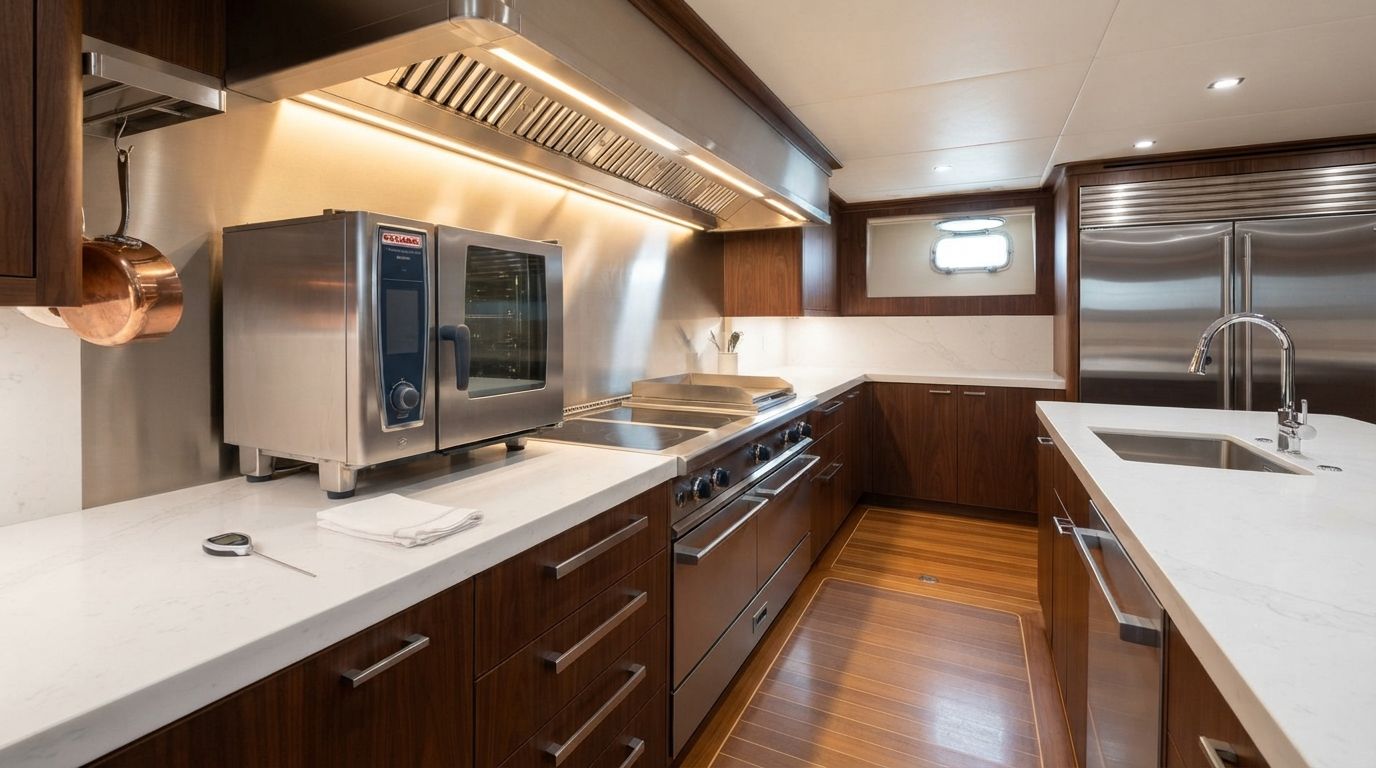
Open flame and LPG storage present real risks on yachts. The case for marine induction cooking — safety, performance, and the brands that deliver it.
Read guide →Europe
Asia Pacific
Americas