Superyacht Galley Refit: What to Expect from Start to Finish
A full superyacht galley refit moves through five distinct phases — from survey to commissioning. Here is what each phase involves and where delays are most likely.
Read guide →
← All Resources / Galley Systems
Gas has been the default in professional and semi-professional galleys for most of the last century. Chefs trained on gas, equipment manufacturers designed for gas, and the concept of a serious kitchen without an open flame felt, for a long time, like a compromise. That perception has changed substantially — and in the marine context, where the arguments for removing gas from the vessel are both safety-driven and regulatory, the case for induction is now compelling.
This article examines the arguments on both sides honestly, looks at the current state of marine induction technology, and explains when gas still makes engineering sense.
LPG — liquefied petroleum gas, comprising propane or butane — is heavier than air. When it leaks from a fitting, a hose, or a regulator, it sinks and accumulates in the lowest available space. On a vessel, that means bilges and enclosed below-deck compartments. The lower explosive limit of propane is 2.1% by volume in air — a concentration that can be reached rapidly in an enclosed space from a small leak. The result, in the presence of an ignition source, is a catastrophic explosion.
This is not a theoretical risk. LPG explosions on recreational and professional vessels are recorded events. SOLAS regulations, the MCA's Large Yacht Code, and most flag state equivalents impose strict requirements on LPG installation, storage, and ventilation precisely because the risk is real and understood. Any LPG installation on a commercial yacht must include a certified leak detection system, automatic gas shut-off valves, a dedicated ventilated gas locker with overboard drainage, and periodic pressure testing of the entire distribution system.
All of that infrastructure adds weight, takes up space, and introduces maintenance requirements. Each component is a potential failure point. The safety architecture for a properly installed LPG system on a commercial yacht is, by necessity, quite complex.
For commercially certificated vessels, the regulatory environment for gas cooking equipment has become progressively more restrictive. Under the 2020 LY3 code (MCA Large Yacht Code) and equivalent flag state regulations, any gas cooking installation must be surveyed and certified at build or refit, with documentation submitted to the flag state authority. Modifications to the LPG system — including adding a new hob or changing a regulator — require a new certificate.
A growing number of new-build superyachts are specified from the outset with fully electric galleys, in part to simplify the regulatory burden and in part because the owners' insurers have begun to apply premium loadings to vessels with LPG cooking systems. In the charter market, where vessels operate under public liability frameworks that scrutinise every risk, this trend is accelerating.
The historical objection to induction among chefs — that it lacks the precise visual feedback and thermal mass response of gas — has been substantially addressed by the current generation of professional induction equipment. A Kenyon Atlantic or Kenyon Multi Flex induction hob designed for marine use delivers zone outputs up to 3.5 kW per zone with continuous boost modes up to 4.5 kW. Response time from zero to full output is under 2 seconds.
In terms of heat transfer efficiency, induction is significantly superior to gas: approximately 85–90% of the electrical energy input is converted to useful heat in the pan, compared to 35–40% for gas (where the majority of heat goes into the surrounding air and the ventilation extract). This means that a 3.5 kW induction zone delivers more useful cooking energy than a 5.0 kW gas burner in the same conditions.
The pan contact requirement of induction — the need for ferromagnetic cookware — is occasionally cited as a limitation. In professional marine galley practice, it is not a significant constraint. All professional-grade cookware used in yacht galleys is induction-compatible, and the move to induction is almost always accompanied by a cookware audit and replacement as part of the commissioning process.
An induction cooking surface has no burners to clean, no pilots to relight, no gas jets to unblock, and no cast-iron grates to degrease. The glass-ceramic surface requires only wiping after use. From a maintenance perspective, the total cost of ownership over a five-year charter operation is significantly lower than an equivalent gas range.
LPG regulator inspection, hose replacement (mandatory at five-year intervals under most flag state regulations), leak testing, and gas locker maintenance all carry ongoing costs that are easy to underestimate at the specification stage. Add the storage space cost of the gas locker and the payload penalty of the LPG cylinders themselves, and the full cost comparison tilts further towards electric.
The resistance to induction among professional chefs is real but declining, and it is strongly associated with familiarity rather than with genuine technical limitations. Chefs who have cooked professionally on high-output induction equipment for a season typically report that it matches gas for most techniques and is superior for low, precise simmering. The techniques where gas has a genuine advantage — wok cooking over open flame, direct charring, flambéing — are either not relevant to the yacht galley context or can be addressed with supplementary equipment.
A hybrid approach, where the primary cooking surface is induction but a single high-output gas wok burner is provided for chefs who specifically require open-flame capability, is a rational compromise on vessels where the chef's preferences are a significant commercial consideration. This arrangement is possible under SOLAS and the Large Yacht Code provided the single gas appliance is independently certified and connected to a dedicated, compliant supply. The LPG infrastructure is proportionally simpler for a single appliance than for a full range.
Kenyon is the dominant brand in marine-specific induction equipment, with a product range designed explicitly for vessel use: sealed housings, salt-air rated electronics, and mounting systems that account for vessel motion. The Kenyon Atlantic (4-zone, 240V) and the Kenyon Multi Flex (modular, variable zone configuration) are the most widely installed options in the 45–70 m superyacht segment. US 120V versions are available for vessels with American electrical systems.
Electrolux Professional's 700 and 900 series induction lines, while designed for the commercial kitchen rather than the marine market specifically, are widely specified on larger superyachts where the full professional kitchen format is required. They are not marine-rated in the same sense as Kenyon, but when correctly installed with appropriate earthing, ventilation, and anti-vibration considerations, they perform reliably in the marine environment.
Zanussi Professional's ProInduction 700 series occupies a mid-market position that offers a good combination of output, reliability, and service availability in Mediterranean markets. For vessels refitting in Turkish yards, Zanussi Professional has the strongest local service network of the three brands.
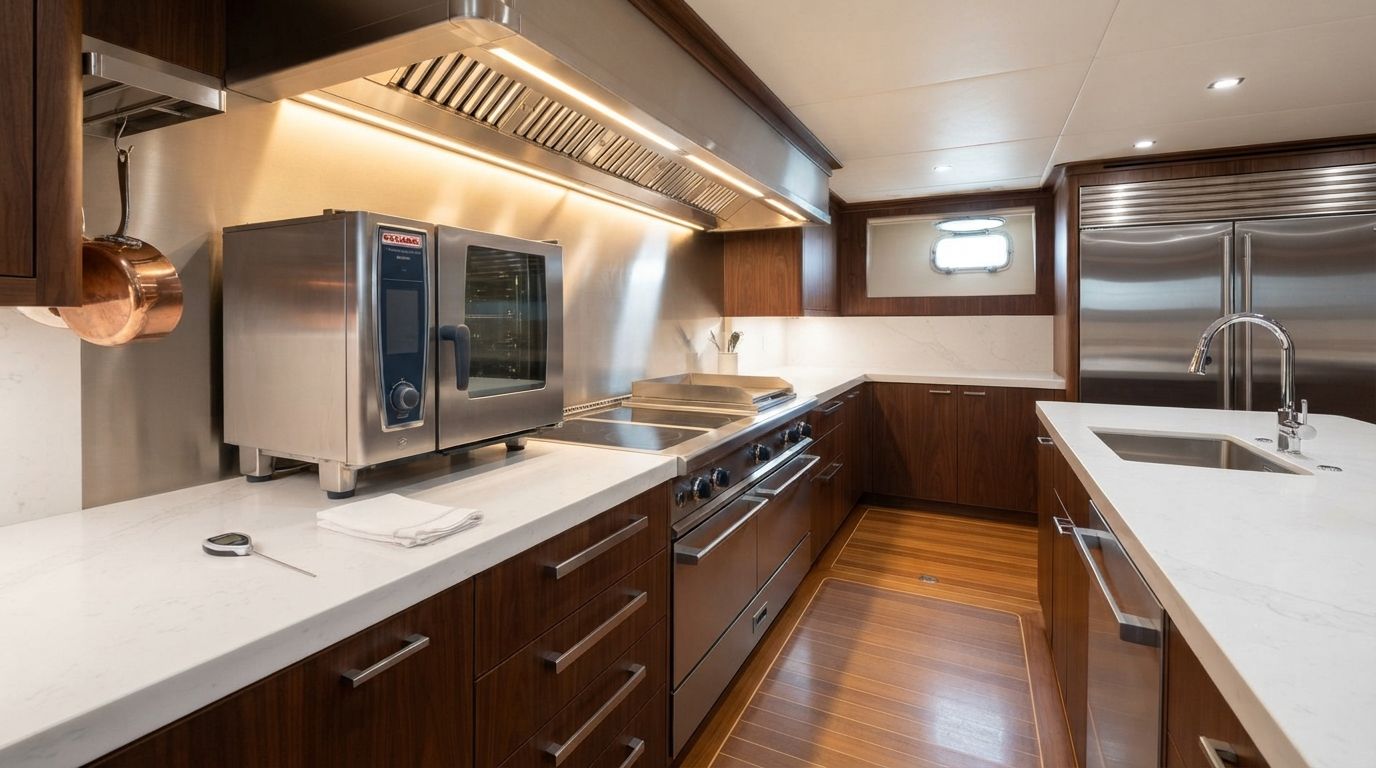
For vessels where gas will be fully removed, the combination of a Kenyon or Electrolux Professional induction suite with a Rational iCombi Pro combination oven covers the full professional cooking function without a single gas connection. This is the specification we install most frequently on new charter superyacht commissions.
Continue Reading
A full superyacht galley refit moves through five distinct phases — from survey to commissioning. Here is what each phase involves and where delays are most likely.
Read guide →
The difference between 316L and 304 stainless steel is a small chemistry change with enormous consequences in marine environments.
Read guide →Europe
Asia Pacific
Americas