Heat-Pump Dryers on Charter Yachts: The Energy Maths
Heat-pump dryers use 50–60% less energy than condenser dryers — and on a charter yacht in summer, the savings compound through reduced AC load.
Read guide →
← All Resources / Laundry Systems
A superyacht laundry room is one of the most operationally critical spaces on the vessel, and one of the most consistently under-specified. It is rarely glamorous, seldom featured in sales brochures, and almost always the first thing that causes problems in charter operation. Getting it right requires understanding not just machine specifications but the rhythm of daily vessel life — how much linen a charter generates, how crew shifts affect laundry scheduling, and what happens when one machine fails mid-passage.
This guide covers the complete specification process: how to calculate the capacity you actually need, how to select and balance equipment, how to approach the anti-vibration and structural requirements, and what the energy load implications are for vessel power planning.
The starting point for any laundry specification is a realistic daily linen load calculation. The industry-accepted formula for charter superyachts is: (number of guests × 3.5 kg/day) + (number of crew × 1.5 kg/day) = minimum daily wash capacity in kg. The guest multiplier accounts for bath towels, beach towels, bed linen, and personal items at typical charter usage rates. The crew multiplier is lower because crew linen change is on a different cycle.
For a 50-metre vessel with 10 guests and 8 crew, this gives: (10 × 3.5) + (8 × 1.5) = 35 + 12 = 47 kg/day minimum. In practice, you should design to 120–130% of this figure to accommodate peak days — turnaround days between charter legs when all linen is changed simultaneously, or active itineraries where towel usage is high. Design capacity for that same vessel should therefore be approximately 58–62 kg/day.
To convert daily kg capacity into machine specifications, divide by the number of wash cycles you can realistically run per day. A full wash-and-spin cycle on a modern 11 kg domestic-spec marine washer takes approximately 75–95 minutes. An industrial washer with programmable short cycles can complete a load in 45–55 minutes. Assuming 16 operational hours per day, a single 11 kg machine can process approximately 10–12 cycles, giving a daily capacity of 110–132 kg. A single machine would technically suffice for our example vessel — but single-machine laundry rooms are a significant operational risk.
The relationship between washer and dryer capacity is frequently misunderstood. The natural assumption is that one dryer is needed for every washer. In practice, dryers are the bottleneck in a well-designed laundry room because the drying cycle is longer than the wash cycle and because heat-pump dryers (the correct choice — see below) have a longer cycle time than resistive dryers.
The practical design rule: plan for dryer capacity that is 130–140% of washer capacity. If your two washers can process 22 kg per cycle, your dryers should collectively handle 28–30 kg per cycle. This allows the dryer to keep up when both washers complete cycles close together — which, in real operation, happens regularly.
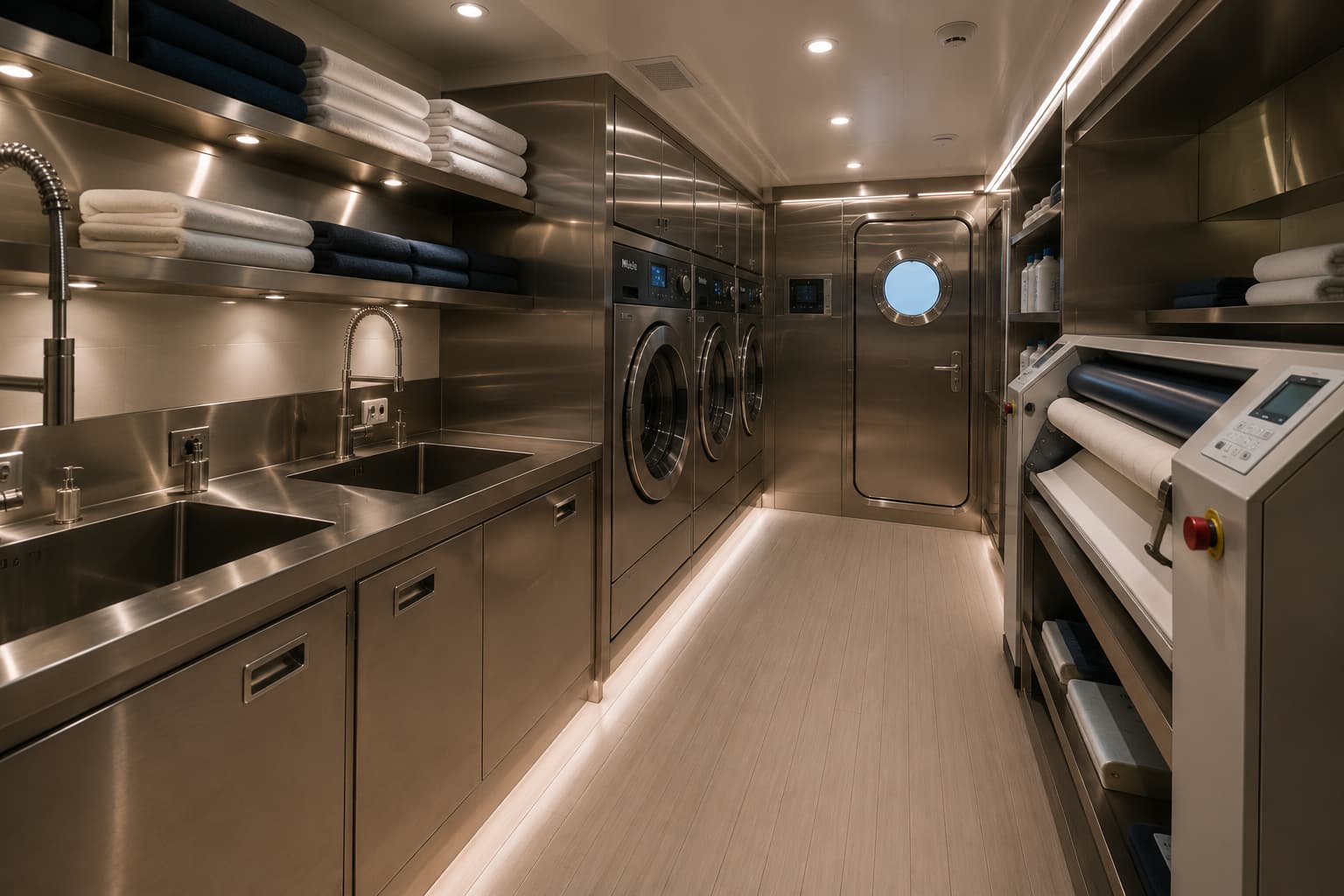
For most superyachts in the 40–65 m range, a configuration of two 11–14 kg washers paired with two 11–14 kg heat-pump dryers represents the baseline. A cylinder mangle then handles the volume work — bed sheets, duvet covers, tablecloths — more efficiently than a tumble dryer and frees the dryers for towels, uniforms, and smaller items.
This decision has a clear right answer for most superyacht applications: heat-pump dryers. A heat-pump dryer recycles the hot air inside the drum rather than exhausting it, using roughly 50–60% less electrical energy than an equivalent resistive condenser dryer. On a vessel where the generator is running and electricity is effectively free, that sounds like an operational detail — but it is not.
The energy a condenser dryer dumps as heat has to go somewhere. On a vessel in summer operation, that heat enters the accommodation HVAC load and has to be removed by the air conditioning system. The result is a compounding energy penalty: the dryer uses its own power, and then the air conditioning uses additional power to compensate for the heat it generates. In a typical Mediterranean summer, a resistive condenser dryer running four cycles a day can add 2–4 kWh to the AC load in addition to its own 4–5 kWh of direct consumption.
Heat-pump dryers eliminate this penalty. They also operate at a lower drum temperature — typically 45–50°C compared to 70–80°C for resistive dryers — which reduces wear on fabrics and extends the service life of linen. The trade-off is a slightly longer cycle time (typically 15–25 minutes longer) and a higher purchase cost.
A cylinder mangle (also called an ironing mangle or flatwork ironer) is a heated roller press that handles flat linen at high volume — bed sheets, duvet covers, tablecloths, napkins. A domestic steam iron would take 4–6 minutes per item; a cylinder mangle processes the same item in 30–45 seconds. For a vessel with 6–8 double cabins changing linen on a weekly charter cycle, this difference is operationally significant.
The case for a mangle becomes compelling on vessels above 40 metres with charter activity. Below that threshold — private vessels with limited guest capacity and flexible linen routines — a mangle is a luxury rather than a necessity. For charter yachts above 50 metres, and particularly those with formal dining and table linen requirements, a 60–80 cm wide cylinder mangle should be considered standard equipment rather than an optional upgrade.
Electrolux Professional and Miele both offer compact marine-suitable mangle options. The Electrolux HS10 and HS17 models are widely specified on Mediterranean superyachts and have good service availability in Turkish and Spanish yards.
Washing machines on vessels without anti-vibration isolation transmit significant vibration to the hull structure — detectable as noise and movement in accommodation spaces, sometimes several decks away. On a vessel where guests are paying several thousand euros per day, this is unacceptable. On a vessel where the laundry room shares a bulkhead with a guest cabin, it is a liability.
The correct approach is a custom-fabricated 316L stainless steel base frame incorporating compressed rubber anti-vibration mounts. The mounts are selected to match the mass of the installed equipment and its vibration frequency profile. At Vista Marine, we calculate the required isolator stiffness and specify mount sets from manufacturers such as Vibro-Acoustics or GMT. The assembled base, when correctly designed, reduces transmitted vibration by 85–95%.
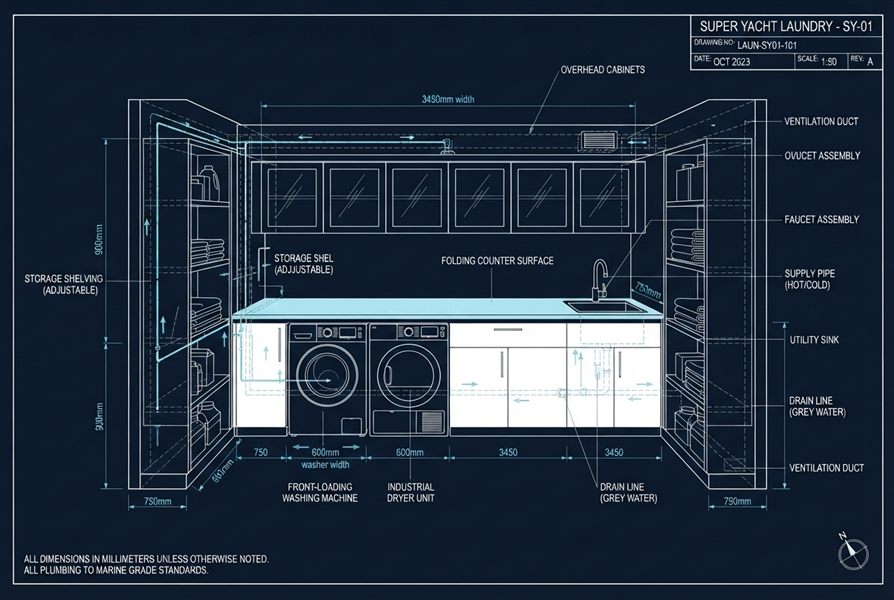
Space planning should allow a minimum clear working area of 800 mm in front of each machine and a service clearance of 400 mm to the sides and rear. Forced ventilation must be calculated for the thermal load of the equipment — heat-pump dryers are significantly better here — and a floor drain with a 50 mm trap is mandatory. Design the door openings to allow machine removal without structural modification: laundry machines have a ten-year replacement cycle and the access details are often only thought about when it is already too late.
A typical twin-washer, twin-heat-pump-dryer laundry room for a 50-metre superyacht has a connected load of approximately 14–18 kW. Running simultaneously, the peak demand is around 12–15 kW. Add a cylinder mangle (3–5 kW) and a steam ironing station (2.4 kW) and the peak load approaches 20 kW.
Laundry rooms should be on a dedicated electrical circuit with adequate cable cross-section for the design load plus a 25% headroom margin. Machine start-up current (inrush) is typically 2.5–4× the running current and must be accounted for in the main switchboard design. Discuss load scheduling with the vessel's chief engineer — running all laundry equipment simultaneously during low-demand periods (early morning, during passage) avoids peak generator loading and can reduce fuel consumption.
Continue Reading
Heat-pump dryers use 50–60% less energy than condenser dryers — and on a charter yacht in summer, the savings compound through reduced AC load.
Read guide →
The difference between 316L and 304 stainless steel is a small chemistry change with enormous consequences in marine environments.
Read guide →Europe
Asia Pacific
Americas