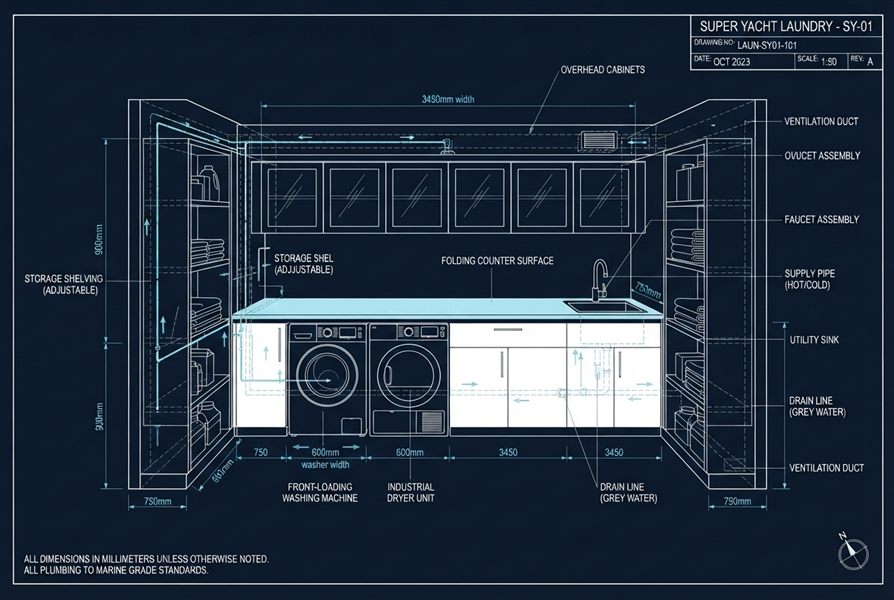
How to Specify a Superyacht Laundry Room: A Practical Guide
Laundry capacity, machine sizing, anti-vibration design, and energy planning for superyacht laundry rooms — a working specification framework.
Read guide →
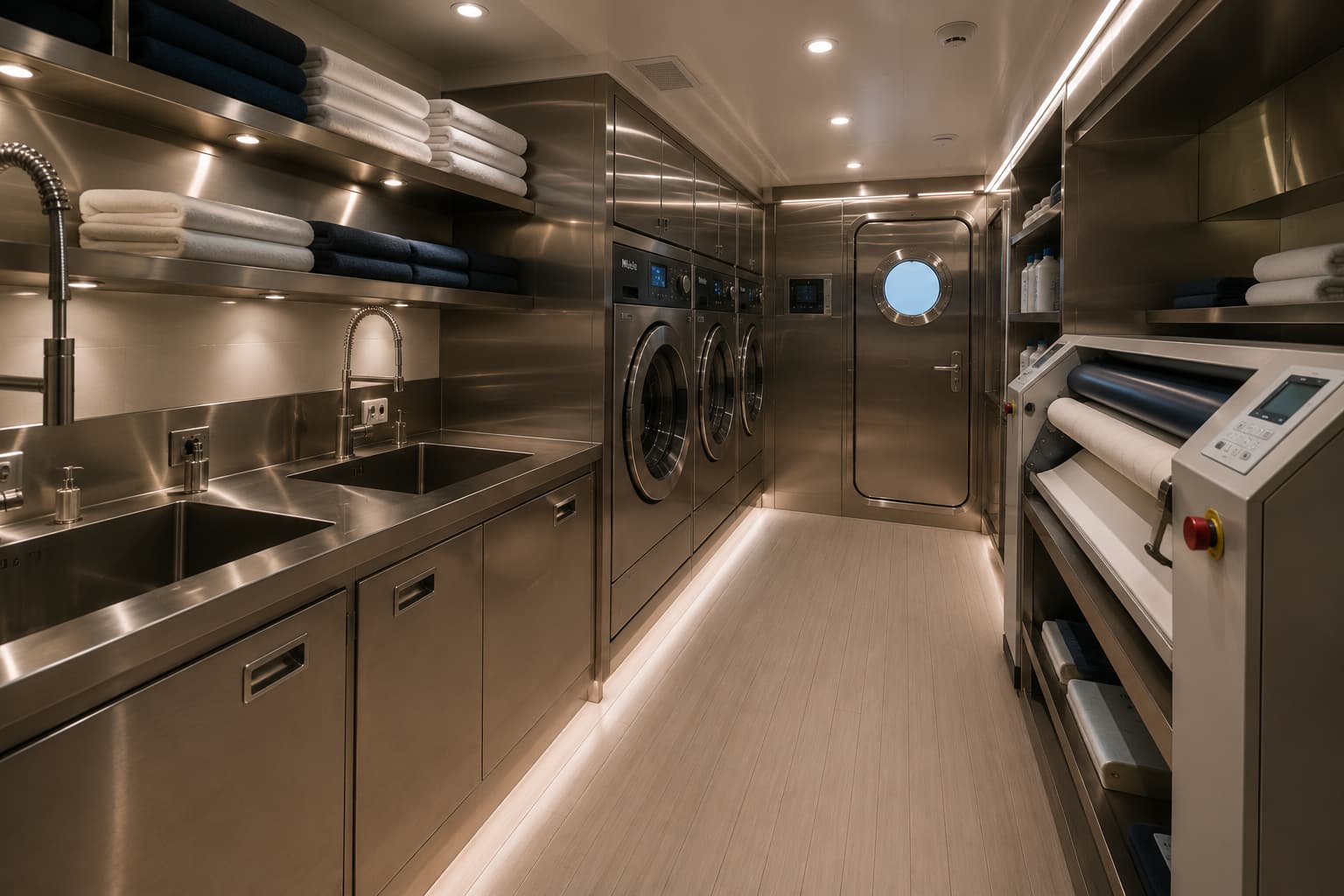
← All Resources / Laundry Systems
The conversation about heat-pump dryers on yachts usually starts with a simple statistic: they use around half the electricity of a conventional condenser dryer. That alone makes a compelling case. But on a charter vessel operating in summer, the full energy story is more interesting — and the savings are larger than that headline figure suggests.
This article walks through the thermodynamic principles, runs an actual kWh comparison with real product specifications, and calculates a return-on-investment timeline that accounts for the broader impact on the vessel's cooling load.
A conventional condenser dryer works by blowing hot air (70–80°C) through the drum, collecting the evaporated moisture in a condenser unit, and exhausting the remaining heat either overboard or into the room. The heating element runs continuously throughout the cycle. The energy input is mostly converted to heat, and then exhausted.
A heat-pump dryer substitutes a refrigeration circuit for the heating element. Warm, moist air from the drum passes over a cold evaporator coil, which condenses the moisture out of the airstream and collects it in a tank or drain. The now-dry cold air then passes over the hot condenser coil of the same refrigeration circuit, where it is reheated and returned to the drum. The refrigeration circuit is doing double duty: dehumidifying the airstream on the cold side and reheating it on the warm side. The only energy input is the compressor running the refrigeration circuit — not a heating element.
The practical result is a drum operating temperature of 45–55°C (compared to 70–80°C for resistive types) and an energy consumption roughly 50–60% lower for the same dry load. The lower drum temperature is gentler on fabrics and measurably reduces fibre degradation over the service life of the linen.
To make this concrete, compare two machines commonly specified on charter yachts: the Miele PT 8503 Comfort heat-pump dryer versus a conventional condenser dryer of equivalent drum size. The Miele PT 8503 is rated at 1.94 kWh per cycle on its standard cotton programme (8 kg load). A comparable condenser dryer with resistive heating runs at approximately 4.5–5.2 kWh per cycle for the same load.
Assume four drying cycles per day during the charter season — a conservative figure for an active 10-guest yacht. The annual difference over a 180-day charter season: (4.5 kWh − 1.94 kWh) × 4 cycles × 180 days = approximately 1,843 kWh per dryer. With a typical superyacht generator fuel cost of €0.25–0.35/kWh (diesel at current EU prices), that is €460–645 per dryer per year in direct fuel savings. For a twin-dryer installation, the annual fuel saving is €920–1,290.
The above calculation understates the real saving. A condenser dryer that exhausts heat into the laundry room creates a thermal load that the vessel's HVAC system must remove. In a typical Mediterranean July, with ambient seawater temperature around 24–26°C and ambient air at 32°C, the HVAC system is already working near its design limits.
A single 5 kW resistive condenser dryer running 4 cycles per day dumps approximately 20 kWh of thermal energy into the accommodation spaces each day. Removing that heat via chilled water HVAC has a COP (coefficient of performance) of approximately 2.5–3.5 in typical marine conditions. The additional HVAC energy to compensate is therefore 20 ÷ 3.0 = approximately 6.7 kWh per day, or 1,206 kWh over a 180-day season.
A heat-pump dryer, by contrast, moves heat from the airstream into the refrigerant circuit and exhausts it as a much smaller, lower-temperature difference. Its net thermal contribution to the accommodation space is approximately 15–20% of a resistive dryer running the same load. The HVAC penalty is negligible.
Adding the direct energy saving and the HVAC load reduction: the total annual benefit per heat-pump dryer, compared to a condenser type, is approximately 1,843 kWh (direct) + 1,100 kWh (HVAC avoided) = 2,943 kWh, or €735–1,030 per year at current generator fuel costs.
The Miele PT 8503 Comfort heat-pump dryer is priced at approximately €2,800–3,200 supply-only in the EU market (2025 pricing). An equivalent condenser dryer costs approximately €1,400–1,800. The premium for heat-pump technology is therefore approximately €1,400–1,500 per unit.
Using the conservative energy saving estimate (€735/year per dryer): payback period = €1,450 ÷ €735 = approximately 2 years. Using the upper estimate (€1,030/year): payback in under 18 months. For a vessel with a 10–15 year operating horizon, the heat-pump dryer pays for itself multiple times over.
Heat-pump dryers run at lower drum temperatures and slightly lower fan speeds than conventional dryers, which translates to a measurable noise reduction. Typical A-weighted sound power levels for heat-pump dryers are 63–67 dB(A) compared to 68–74 dB(A) for resistive condenser dryers. In a laundry room adjacent to guest accommodation, this difference is perceptible and relevant.
The vibration profile of heat-pump dryers is also typically better. The refrigeration compressor adds a low-frequency component that must be accounted for in the anti-vibration mount design, but the overall transmitted vibration at the design spin speed is similar to or lower than conventional dryers.
The Miele PT 8503 Comfort and PT 8503 HP are the most commonly specified heat-pump dryers for superyacht laundry rooms. The PT 8503 HP includes enhanced marine-grade electronics protection and is the specification we recommend for any vessel with significant offshore or open-ocean operation. Electrolux Professional's T5 and T7 heat-pump series offer higher capacities (11–14 kg) suitable for larger charter yachts.
Installation requirements: heat-pump dryers require a condensate drain connection (or an accessible tank that crew will empty regularly — in practice, a drain connection is always preferred). They require slightly more clearance for heat exchange than condenser dryers — allow 100 mm behind the unit. And because the refrigeration circuit adds a small amount of weight and vibration complexity, the anti-vibration base should be specifically calculated for the heat-pump model rather than reusing a base designed for a conventional dryer.
The one genuine downside: cycle time is 15–25 minutes longer per load than an equivalent condenser dryer. For a busy charter laundry room, this should be factored into the daily scheduling. It rarely changes the fundamental equipment sizing decision, but it is worth communicating to the chief stewardess during commissioning.
Continue Reading
Laundry capacity, machine sizing, anti-vibration design, and energy planning for superyacht laundry rooms — a working specification framework.
Read guide →
A full superyacht galley refit moves through five distinct phases — from survey to commissioning. Here is what each phase involves and where delays are most likely.
Read guide →Europe
Asia Pacific
Americas